Welcome the resistance curiously!
We want change. We resist uncertainty. And because our identities provide us with a particularly powerful form of certainty, we can end up defending the very version of ourselves we're trying to change.
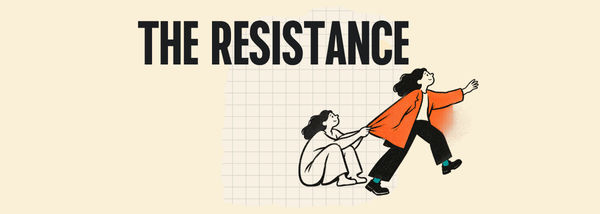
We want change. We resist uncertainty. And because our identities provide us with a particularly powerful form of certainty, we can end up defending the very version of ourselves we're trying to change.
It’s commonly said we resist change. I see the resistance all the time within myself, within the team and with our students. There’s this desire to change and, running alongside it, a whole bunch of reasons and justifications that keep us where we are. Often the resistance runs so deep we don’t see it ourselves.
We could describe the tension between desire for change and resistance as: we want our lives to change AND we want to remain the person we already know how to be.
This connects neatly with the existing Make Happen idea that acceptance of the present is not the enemy of change. You can be okay as you are AND choose to become different. Indeed, this, I believe, is the magic of our programme over many other personal growth journeys, which can create more “I’m not good enough”.
So… where does this tension between change and resistance come from? For most of human evolution, the familiar was relatively predictable. Novelty might contain opportunity, but it might also contain danger. A nervous system that treated every unknown thing as exciting would not necessarily have enjoyed a long evolutionary career. An unfamiliar plant might be nutritious... or poisonous. An unfamiliar animal might give you a cuddle... or eat you. An unfamiliar territory might contain food and fun stuff... or predators. An unfamiliar person might become a member of your band... or attack you.
So it seems we contain two fairly fundamental and competing impulses. Explore AND protect. Move AND stay. Discover AND conserve. We want the new career AND the security of the old one. We want to become visible AND avoid judgement. We want success AND fear what success might demand of us.
The thing to note… change has a hidden price: uncertainty. We tend to imagine change in terms of its benefits. More of what we want. More money. Better work. A finished book. A new business. But getting there means surrendering some prediction and control. And that lack of control, for many of us, can feel terrifying. Is it any surprise we get snarky, contracted, hostile, despondent etc.?
And it isn't only our circumstances we're protecting. We're also protecting our sense of who we are. Let’s not forget one of Make Happen’s favourite topics: identity. You see, our behaviour isn't floating freely. It gets knitted into our stories about who we are. “I am…” may be two of the most powerful words in language. I'm shy. I'm chaotic. I'm a perfectionist. I'm an introvert. I'm a rebel. I'm creative. I'm terrible with money. I'm not a salesperson.
Once description becomes identity, changing the behaviour can begin to feel like betraying the self. Identity turns yesterday into tomorrow. Something may have begun as an observation about repeated behaviour. Eventually, it becomes an explanation for future behaviour. Labels can illuminate AND imprison. A diagnosis, for example, may provide genuinely useful understanding and access to support. But “therefore I cannot possibly work this way” is another move entirely. A useful description can quietly become a boundary.
Positive identities can be just as restrictive. I'm creative can mean “I don't do accounting”. I'm a rebel can mean “I won't follow a useful structure”. I'm spontaneous can mean “I don't plan”. I'm authentic can become “I shouldn't adapt”. The identity sounds liberating while policing our behaviour. It can also protect us from ‘getting things wrong’. The most ardent rebel (I’m talking about me here!) can use their “I don’t do things properly” as a shield against “I can’t do things properly”… again, I am a master at this!
All of this is why we like to reframe identities in Make Happen as… “I have a habit of describing myself as...” When we say “I have a habit of describing myself as a procrastinator”, we open the door to possibility. Less fixed. Less risk that any change will feel like a shift in who we think we are.
Change isn't primarily about defeating resistance. Resistance isn't necessarily something to obey OR overcome. It’s something to get curious about. What am I protecting? What might I lose if I changed? What identity would this action contradict?
I’ll end with a list of possible ways we resist. Any feel familiar? Any others to add? Let me know about your resistance in the comments. Any resistance is totally okay… a little curiosity may just open up some possibility!
Overthinking ... thinking becomes a substitute for moving.
Procrastinating ... “I’ll do it when I’m ready.”
Over-planning ... another plan feels safer than the first action.
Perfectionism ... making the standard high enough that nothing has to be released.
Researching endlessly ... one more book, podcast, course, YouTube video.
Waiting for clarity ... insisting you must know where you're going before taking a step.
Waiting for confidence ... as though confidence comes before action rather than from it.
Waiting for motivation ... giving a feeling veto power over a commitment.
Getting busy ... doing lots, except the thing that might actually change something.
Starting something new ... particularly when the existing thing becomes difficult or boring… yes, the New Shiny Thing folks!
Constantly changing direction ... every new possibility rescues you from committing to the last one.
Keeping your options open ... because choosing one thing means losing all the others.
Not finishing ... completion means the work can finally be judged.
Not sharing ... your work remains wonderfully full of potential while nobody can see it.
Polishing ... fixing things nobody else will notice rather than putting the work into the world.
Avoiding feedback ... protecting the work from information that might require change.
Explaining yourself ... producing a compelling account of why you haven't acted.
Justifying ... converting avoidance into something that sounds rational.
Blaming circumstances ... locating the possibility of change somewhere outside yourself.
Blaming other people ... “I could, if only they...”
Needing permission ... waiting for somebody else to make your choice safe.
Asking everyone’s opinion ... outsourcing a decision until nobody can quite be blamed for it.
Arguing with feedback ... explaining why the person giving it doesn't really understand.
Getting defensive ... experiencing information about behaviour as an attack on identity.
Getting snarky ... turning discomfort into contempt.
Getting hostile ... attacking the challenge rather than examining what it threatens.
Withdrawing ... disappearing when things become uncomfortable.
Going quiet ... withholding participation so nothing of you is at stake.
Becoming despondent ... “What's the point?” can sometimes protect us from finding out.
Catastrophising ... turning a difficult next step into an imagined disaster.
Making it complicated ... complexity can provide excellent camouflage for inaction.
Demanding certainty ... wanting guarantees from a future that cannot provide them.
Focusing on everything that could go wrong ... while barely considering what might happen if it goes right.
Focusing on the method ... becoming obsessed with how you’re doing it while losing sight of the intention.
Looking for the RIGHT way ... because experimentation involves the possibility of being wrong.
Rejecting structure ... “I'm creative. I don't work like that.”
Rejecting spontaneity ... “I need a proper plan before I can begin.”
Turning preference into identity ... “That's simply not who I am.”
Using diagnosis as destiny ... turning something that explains difficulty into something that declares impossibility.
Using authenticity as armour ... “I need to be true to myself” when adaptation threatens the familiar self.
Using rebellion as protection ... “I refuse to do it properly” can sometimes protect “I'm frightened I can't.”
Using independence as protection ... “I work better alone” avoids asking, collaborating and being seen.
Performing competence ... refusing to become a beginner because looking capable matters too much.
Performing incompetence ... “I'm hopeless at this” conveniently lowers what anyone can expect from you.
Making jokes about yourself ... “You know me, I'm always late!” turns a changeable behaviour into a charming character trait.
Breaking commitments quietly ... renegotiating with yourself once nobody is watching.
Moving the goalposts ... redefining what you promised after discovering what fulfilling it actually requires.
Finding fault with the opportunity ... once something becomes real, suddenly noticing everything wrong with it.
Romanticising the old version of yourself ... remembering the comfort of where you were and forgetting why you wanted to leave.
Saying “this is just who I am” ... perhaps resistance's finest work, because the possibility of change disappears inside the phrasing.
Written by a human 🕺🏽, grammar checked by a robot 🤖!