The Procrastination Paradox: Why Your Brain Is Actually Right
Here's something nobody tells you about procrastination: it's not a character flaw. It's a prediction error.
Here's something nobody tells you about procrastination: it's not a character flaw. It's a prediction error.
Your brain has spent millions of years getting remarkably good at one thing… keeping you alive. Not making you productive. Not helping you meet deadlines. Just alive. And right now, it's looking at that blank document, that unfinished project, that phone call you need to make, and it's calculating: "High effort, uncertain outcome, potential social rejection. Hard pass!"
Your brain isn't broken. It's just doing exactly what it was designed to do.
The Quantum State of Unmade Decisions
We love a bit of physics here at Make Happen… and in quantum mechanics, particles exist in superposition… simultaneously in all possible states until observed. Your unstarted project lives in a similar space. Whilst it remains undone, it's still perfect. Still brilliant. Still world-changing. The moment you begin, you collapse that wave function into something actual, something that can be evaluated, criticised, or… horror of horrors 😱… revealed as merely good enough.
Procrastination, then, isn't about laziness. It's about maintaining possibility whilst avoiding actuality.
The problem? Your brain can't tell the difference between a genuine threat (say, a tiger) and a manufactured one (an email you need to send). Both trigger the same cascade: cortisol floods your system, your amygdala fires, and suddenly checking your phone for the seventeenth time feels absolutely vital to your survival!
The Zeigarnik Trap
Bluma Zeigarnik discovered something fascinating in the 1920s: unfinished tasks create a kind of cognitive tension. They loop. They intrude. They occupy mental real estate long after you've moved on to your fourth cup of coffee and your third YouTube video about decluttering (the irony isn't lost on me either).
But here's where it gets interesting. That tension? It's not there to torture you. It's there to motivate completion. Your brain is essentially saying, "Right, we've started this, now we need to finish it." The problem is we mistake that tension for anxiety and try to escape it through... more procrastination. We're essentially running from the very mechanism designed to help us.
The Doing Motivation Reversal
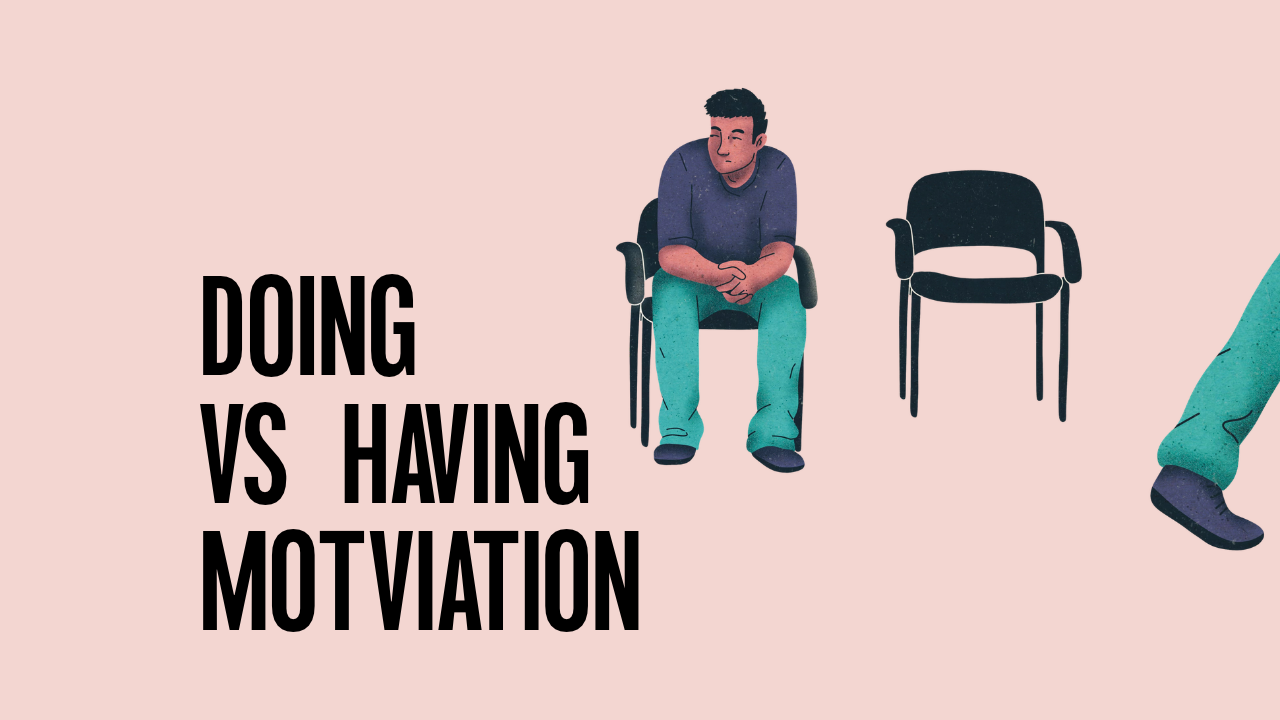
Most people wait to feel motivated before they act. This is precisely backwards.
Motivation isn't the cause of action… it's the consequence. You don't write because you're inspired; you become inspired because you've started writing. The neurons associated with task completion only fire when you're actually doing the thing. Not thinking about doing the thing. Not planning to do the thing. Doing the thing.
This is neuroplasticity in action. Each time you override the procrastination impulse and take even the smallest action, you're literally rewiring your brain. You're creating new neural pathways that make the next action slightly easier. But you have to go first.
The Now That Never Arrives
You've probably noticed this: tomorrow you'll definitely do it. Tomorrow you'll be more motivated, more focused, more ready. Except tomorrow never comes because when it arrives, it's called today, and… ahem… you're still not ready.
This is because you're attempting to do something in a time that doesn't exist. There is no tomorrow in which you'll take action. There's only ever now, and another now, and another now after that. The question isn't "when will I do this?" but "what's the smallest possible action I can take in this specific now?"
Not "I need to write the article." But "I'm opening the document." Not "I have to finish the project." But "I'm spending three minutes on the first task."
The Discomfort Threshold
Here's what procrastinators already know but don't want to admit: you're not avoiding the task. You're avoiding the discomfort of the task.
That email you need to send? The discomfort isn't in the sending… it takes 90 seconds. It's in the anticipation of the response. That project you need to start? The discomfort isn't in the work… it's in potentially discovering you're not as good as you hoped.
The Stoics understood this. Seneca wrote that "we suffer more in imagination than in reality." Your brain is running disaster scenarios that haven't happened and, statistically, won't happen. But those scenarios feel real enough to trigger genuine physiological responses.
The solution isn't to eliminate discomfort. It's to develop what we might call discomfort tolerance… (you’ll probably know by now, we call it discomfortable) the capacity to feel uncomfortable and act anyway. Not because you're brave. Not because you're disciplined. But because you've realised that the discomfort of procrastination (the Zeigarnik loop, the mounting dread, the self-flagellation) is actually worse than the discomfort of action.
The Specificity Principle
"I need to work on my project" is not an action. It's an abstraction. Your brain can't execute abstractions.
"I'm going to spend 12 minutes writing the opening paragraph" is an action. It has parameters. It has a start and an endpoint. It exists in time and space.
Procrastination thrives in vagueness. Action requires specificity. Not "I should exercise more." But "I'm doing three press-ups right now." Not "I need to sort out my finances." But "I'm opening my bank statement at 2pm today."
The more specific you are, the less room there is for your brain to negotiate. Negotiation is where procrastination lives.
The Two-Minute Rebellion
Here's your way out: pick the thing you're procrastinating on right now. Not later. Now.
Identify the smallest possible action you could take… something so small it would be almost embarrassing to call it progress. Two minutes. Maybe less.
Not "research the entire topic." Just "open one article." Not "draft the proposal." Just "write the first sentence." Not "organise the whole space." Just "move one object."
Then… and this is crucial… do only that. Don't extend it. Don't push yourself. Do the tiny thing and stop. Your brain needs to learn that starting doesn't mean committing to hours of suffering. It means taking one breath-sized action.
Do this once. Then do it again tomorrow. Then again.
You're not building discipline. You're building evidence. Evidence that starting isn't dangerous. Evidence that you can survive the discomfort. Evidence that action, not hope, is what shifts actuality.
The procrastination will still be there tomorrow. It's part of being human. But so is the capacity to act despite it.
Do This Now
Close this article. Choose one thing you've been avoiding. Identify the smallest possible first action (under 3 minutes). Set a timer. Do it.
Don't think. Don't plan. Don't prepare. Just move.
Your brain will thank you later. But more importantly, it'll have learned something new: that you're capable of starting. And starting, it turns out, is the only thing that ever needed to happen.
* * *
References:
Bluma Zeigarnik (1927) - "On Finished and Unfinished Tasks" - Initial research establishing the Zeigarnik Effect, demonstrating superior recall of interrupted tasks.
Seneca (c. 65 CE) - Letters from a Stoic - Philosophical letters exploring resilience, time management, and managing anxiety through rational thought.